Ten minutes can be enough to study a silhouette, compare proportions, or test a new mark. It is usually too little time to understand a complicated subject and polish every detail. Choosing a smaller task gives the session a clear stopping point.
Use this routine as a flexible practice plan. You do not need to draw every day or protect a streak. Record what you tried, what you noticed, and what you decide to practice next so that short sessions connect to each other.
Make starting easy
Keep a pencil, eraser, and small sketchbook together. Loose paper in a folder works too. Choose a setup you can open in a minute without clearing a whole desk. If preparation takes most of the available time, simplify it before adding another supply.
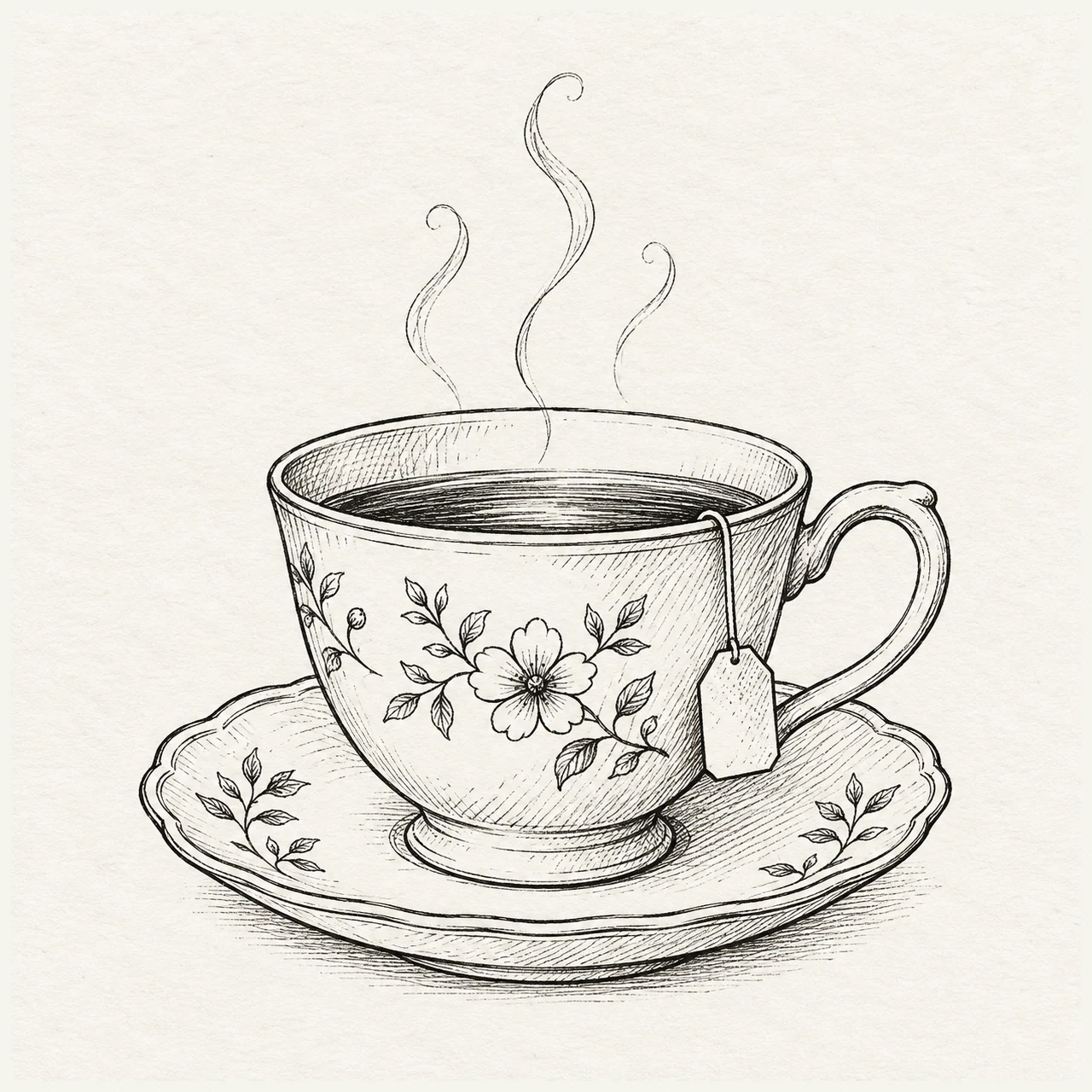
Save three references in advance: one very simple, one familiar, and one that stretches a skill you want to practice. Give each a job. A cup can be for ellipses, a leaf for contours, and a cat for overlapping shapes. Pick from that list rather than scrolling until the session disappears.
Attach the session to a part of your day that leaves room for it, such as the end of a lunch break. If that time regularly fails, choose another. Setting up the same object and tools again should take less effort than searching for a completely new exercise every time.
Give each session one question
Write a question at the top of the page. “Can I make the handle opening the right size?” is more useful than “Can I draw a good cup?” You can answer the first by comparing two shapes, even if the rest stays unfinished.
Match the task to the time. For contours, leave out shading. For shading, use a shape you can sketch quickly. For line confidence, repeat a curve on scrap before using it in a small subject. Trying to improve proportion, perspective, texture, and composition in one session makes review vague.
Reduce the subject when necessary. If a whole plant is too much, draw one leaf and where it joins the stem. If a portrait is too involved, study the head's outline from one view. Write that smaller task down so you can recognize when you have completed it.
Divide ten minutes into looking, drawing, and review
Set a timer if it helps you begin. Use it as a reminder to check your work, not to rush your hand. Try this division with a simple object or saved reference.
- Minutes 0–1: choose the question. Look at the reference and identify the two or three shapes that matter to today's task.
- Minutes 1–3: place the whole subject lightly. Mark the outer limits and compare the biggest proportions. Leave small details out so you can still move the large shapes.
- Minutes 3–7: work on the chosen skill. Refine the contour, compare empty spaces, or add a limited shadow pattern. Leave other interesting details for another session.
- Minutes 7–9: compare the drawing with the reference. Correct the largest mismatch connected to your question rather than adding decoration to fill the time.
- Minutes 9–10: date the page and write one observation. Put the pencil back beside the sketchbook and choose a possible subject for next time.
Try a week of connected exercises
These are seven sessions to spread across a week or several weeks. Keep your first subject available so you can return to it without a new setup.
- Session 1 — silhouette: draw the outer shape of a cup or leaf three times. Compare height and width. Leave the interiors empty.
- Session 2 — proportions: draw it again, marking the largest shapes first. Check where one part sits in relation to another.
- Session 3 — negative space: focus on the handle opening or gaps between leaves. Compare those empty shapes before changing the contours around them.
- Session 4 — three values: use paper white, a middle gray, and one dark. Keep texture out while arranging the largest light and shadow areas.
- Session 5 — line choice: redraw with a pen or marker if you have one. Choose which edges and details are necessary for recognition.
- Session 6 — a changed view: turn the object slightly or choose a second reference. Notice which proportions change and which landmarks still help.
- Session 7 — repeat and compare: return to the original view. Place the new drawing beside Session 1 and name one change you can see.
Repeat a subject with a reason
Repeat a familiar subject when there is something specific to test. Keep the view, size, and tool similar to compare proportions. Change one of them to explore its effect. A pencil version and a marker version can reveal how much the silhouette contributes without requiring the same shading.
For example, draw a mug once to place the rim, once to check the handle, and once to group the shadows. Keep each study small enough to finish the assigned task. You will have three drawings whose results you can review against different questions.
If repetition becomes dull, choose a neighboring subject using the same skill. Ellipses appear in cups, bowls, and plant pots. Rounded forms appear in fruit, shells, and curled animals. You can change what you draw while keeping the exercise connected.
Keep notes you can act on
Write the date, the question you practiced, and one observation. Replace “bad proportions” with “the cup body is too wide compared with its height.” Replace “needs more detail” with “the shadow under the handle is missing.” A useful note points to something to check on the next page.
After several sessions, compare drawings from a similar view. Look at the skill you practiced before judging the overall finish. A drawing can show better placement and less polished shading together. Keep both facts in the review instead of giving the whole page a single grade.
Take a photo of an early study if you tend to throw pages away. Keep a few imperfect drawings for comparison later. You do not need to post them or turn the record into another project that takes longer than the drawing itself.
Adjust for busy days and missed sessions
For five minutes, use one to look, three to draw the main shape, and one to review. For two minutes, compare a pair of shapes or draw three versions of a curve. Label the study so you remember its purpose. Stop at the smaller task rather than rushing a larger one.
After a missed session, return to the next available page. If you keep avoiding the same exercise, reduce it, change the subject, or choose a more convenient time. A plan that repeatedly goes unused needs adjustment; adding catch-up sessions can make it harder to restart.
When you have longer, extend one part of the routine: observe another angle, develop the shadow pattern, or make a second attempt after review. Keep the original question visible so you can tell whether the extra work helped with the thing you set out to practice.
Choose a practice reference
- A quiet cup of tea
Use one session for the rim, one for the handle opening, and one for the shadow shapes.
- A happy little monstera
Study a single leaf first, then compare the gaps between leaves in another session.